Powered by COREMIN™ · Adding Nature to Life
Make your water a premium mineral water
Over 70 naturally occurring trace minerals from the Great Salt Lake, dosed to a stated figure and certified on every production lot. Purified water becomes something a guest notices — under your own brand, with the composition printed where they can check it.
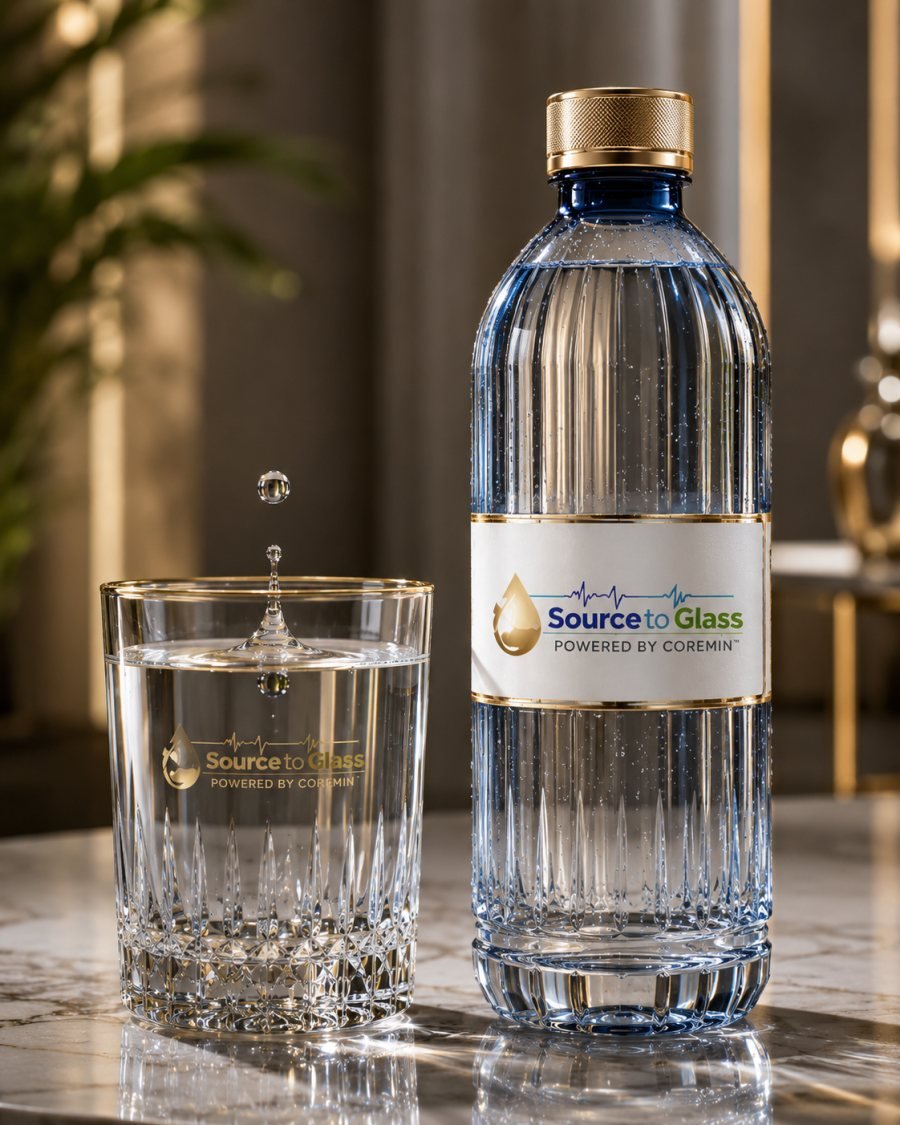
The minerals
Over 70 trace minerals, in the proportions nature arrived at
The Great Salt Lake has no outlet. For thousands of years the rivers have carried minerals in and only the water has left, evaporating and leaving everything dissolved behind. What remains is one of the most mineral-dense inland waters on earth — not a single salt, but the whole spectrum, in the balance the lake produced.
Purity
Harvested from the lake, not manufactured from industrial salts. Nothing is added to make a number look better on a label.
Bioavailability
Minerals in ionic form, dissolved and already in solution — the state water carries them in naturally.
Broad spectrum
Over seventy trace elements, not a short list of the four cheapest with the rest quietly left out.
Trace elements
The ones that are hard to source and easy to omit: lithium, boron, zinc, chromium, selenium and the rest.
A litre of concentrate, a thousand bottles
That ratio is what makes a premium mineral profile affordable at hospitality volumes. The mineral cost lands between five and twelve rupees a bottle depending on the programme — a fraction of what the bottle itself costs, for the only part of it a guest can taste.
- Trace elements carried
- over 70
- Source
- Great Salt Lake, Utah
- Harvested since
- 1969
- Concentrate to bottles
- 1 L ≈ 1,000
- Mineral cost per bottle
- ₹5 – ₹12
- Values recorded
- per production lot
Illustrative of a Signature dosage per litre. The values for any real lot come from that lot’s own approved formulation and its laboratory report.
The mark
Powered by COREMIN™
The Mark of Premium Mineral Excellence
Natural minerals. Intelligent formulations. Premium experiences. The mark is not a sticker — it is the claim that every millilitre in the bottle traces back to Coremin concentrate, through an approved recipe and a certified production run. Four tiers, by what the business is.
Emerging brands
COREMIN Reserve™
For a venue putting its name on water for the first time. The full mineral and certification chain, at entry scale.
Established brands
COREMIN Signature™
For a venue with a reputation to protect. Formulation tuned to the menu, and a profile a sommelier can talk about.
Premium & luxury
COREMIN Prestige™
For properties where the water is part of the service standard. Glass, bespoke dosage, and presentation to match.
Flagship & category leaders
COREMIN Sovereign™
For the house that sets the benchmark. Everything bespoke, from mineral profile to the scan experience itself.
The water problem
What a venue is actually serving, and how it knows
A venue that puts its name on water has to be able to say what is in it. Most cannot: an RO membrane strips the minerals out along with everything else, and what a cartridge or a TDS valve puts back, nobody measured. A cartridge fades as it wears; a valve blends in whatever the feed water is doing that week.
A brand needs a figure it can print, and a laboratory report behind it.
Groundwater carries both
On the way through rock it picks up calcium, magnesium, potassium and trace elements — and, depending on where you are, hardness, nitrate and metals you would rather not serve. The good and the bad arrive dissolved in the same glass.
The membrane cannot tell them apart
So you fit an RO, and it works — it rejects by particle size, not by what the particle is, at around 90–99% across dissolved solids. The contaminants go, which is the point. The minerals go with them, which is the cost.
Putting some back is not knowing
A calcite stage adds mostly calcium carbonate and tapers as it depletes. A TDS valve blends untreated feed water around the membrane. Both make the water taste better. Neither produces a number anyone measured.
A figure you can stand behind
Great Salt Lake concentrate carries over 70 trace elements in the proportions the lake holds them. Dosed to a formulation Coremin approved, recorded against the production lot, backed by a laboratory report — and printed where a guest can check it.
Figures are illustrative of a typical municipal source and a Signature dosage. A real system’s output depends on its feed water, its membrane and whatever stages follow it; the values for any real lot come from that lot’s approved formulation and its laboratory report.
Statements of composition only. Nothing here is a health claim, and nothing here suggests that water from a well-run RO system is unsafe to drink.
Where it goes
Two industries, one mineral chain
The concentrate is the same. What changes is who bottles it, and whose name is on the front.
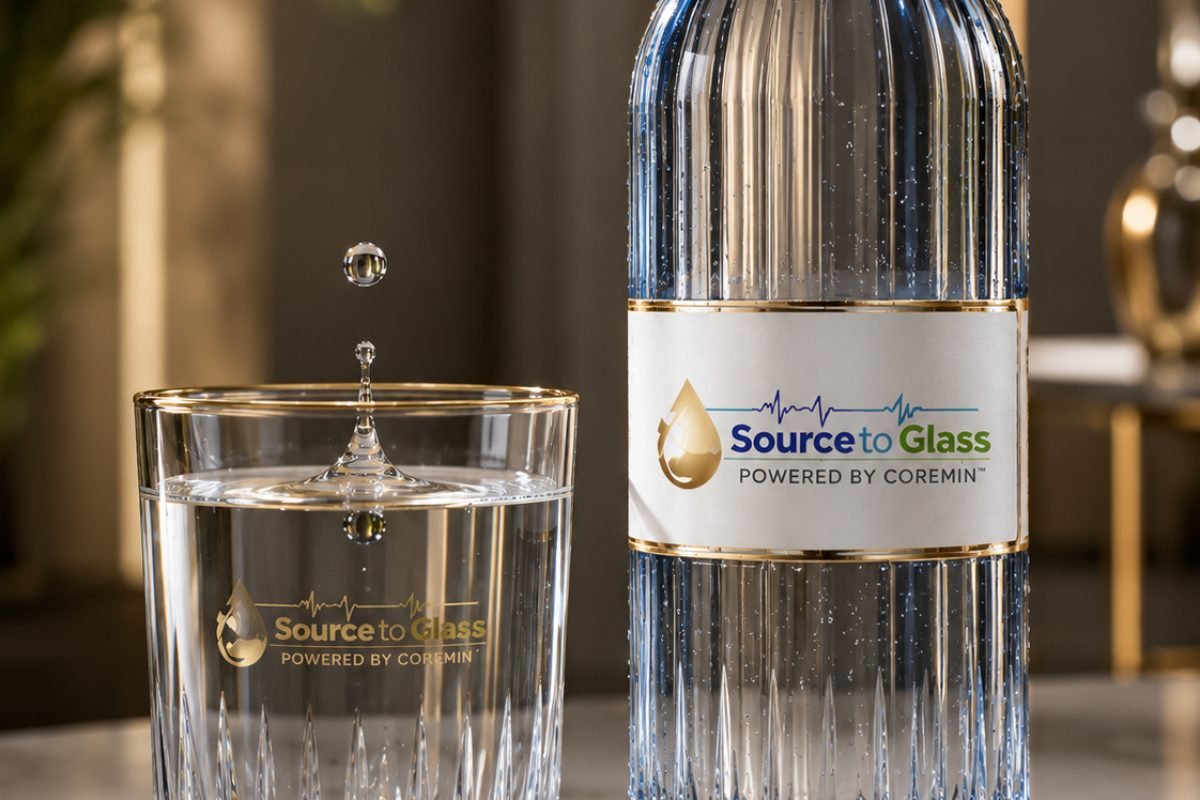
Hospitality
In-house bottling, source to glass
Hotels and resorts already purify water on site and treat it as an overhead. The same line, remineralised and bottled under the property’s own label, becomes something a guest pays for and remembers.
Packaged drinking water
Remineralise what you already bottle
If you already bottle, you already have the line and the licence. Dosing the minerals back in is the cheapest change you can make that a customer can actually taste — and it gives a commodity SKU something to put on the front of the label.
How it works
Four steps, and a venue at the end of them
Coremin supplies the minerals and approves what may be made and claimed. A licensed line makes the water — a contract plant, or the venue’s own. And the venue puts its own name on the bottle and sells it to the guest. Every bottle traces back through all four.
-
1
Coremin
The concentrate
We sell you bulk mineral concentrate from the Great Salt Lake, by the litre and the kilogram. It arrives with its own lot number and expiry, and every finished bottle downstream is measured back against it.
-
2
You & your venue
The brand, approved
Your venue wants its own name on the bottle. You submit the registration; Coremin approves the brand and the formulation behind it. The venue accepts the terms electronically. Nobody prints a label that has not been approved.
-
3
A bottling unit
The production run
A licensed line produces to that approved formulation — a contract plant, or the venue’s own, if it has one. The run consumes concentrate oldest-expiry-first, traced to the drum it came from, and mints a registered batch number with its own expiry.
-
4
The venue
The certificate, then the sale
The venue is emailed an authenticity certificate naming the product, the batch, the expiry and a verification link — and then sells the bottle to its guest, under its own name and at its own price. If a lot is ever recalled, every buyer of record is reachable by name.
Product first. Engagement second. Promotion third. Compliance throughout. That order is deliberate, and it is the order this site is written in.
Traceability
From the source, all the way to the glass
Five hops between a drum of concentrate in Utah and a glass on a table in your city. Every one of them is recorded, and the record is what makes the mark worth anything.
-
1
Coremin · Utah
The source
Concentrate drawn from the Great Salt Lake, one of the world’s most mineral-dense inland waters. It arrives with its own lot and expiry, and everything downstream is measured against it — a finished lot carries the mark only if all of its concentrate came from us.
- Carries
- over 70 trace elements
- Recorded
- grade · lot · expiry
- Measured in
- litre · kilogram
-
2
Hospitality partner
The recipe
The dosage is written once at territory level and approved by Coremin before anything is produced against it. Each version is frozen, so a change tomorrow cannot rewrite what was made today. The mineral values a guest will see hang off the version, each with a laboratory reference.
- Versioned
- frozen once published
- Approved by
- Coremin, per version
- Carries
- composition · lab reference
-
3
Contract bottler
The run
A licensed bottler produces to the approved recipe. Concentrate is drawn oldest-expiry-first and consumed against the lot it came from, and the run records the recipe version it used — which is what lets a scan quote the right numbers years later.
- Draws
- oldest expiry first
- Records
- the recipe version used
- Refuses
- a brand it cannot fill
-
4
The registry
The lot
Every run mints a lot with a registered number and its own certificate. The number goes on the label, as the law requires. The code inside the QR is something else — a long random token, unguessable, and therefore safe to put in a stranger’s hands.
- On the label
- lot · bottled · best before
- In the QR
- a 32-character token
- Certificate
- one per production lot
-
5
The guest
The glass
The bottle reaches a table and somebody scans it. They see the product, the lot, the minerals approved for the recipe that made it, who bottled it under which licence — and the venue’s own offer where there is one. No account, no cookie, nothing asked of them.
- Open to anyone
- no sign-up to read a label
- Shows
- product · lot · minerals · maker
- Never shows
- volumes · buyers · prices
Two routes
Two ways to own your water
The difference is where the bottling happens. Everything else — the minerals, the approvals, the certificate, the scan — is identical.
Source to Glass™
Bottled inside the property, from the property’s own treated water. For hotels, resorts and luxury hospitality with the space and the volume to justify a line.
- ✓No freight on finished water
- ✓Glass or PET, refilled on site
- ✓The strongest sustainability story
- ✓Sustainable options need no capex
Table to Glass™
Finished branded bottles, produced by an approved contract plant and delivered through the hospitality partner network. For restaurants and groups without a line of their own — still their brand, still their sale.
- ✓No plant, no equipment, no licence to hold
- ✓Own label from the first pallet
- ✓Order through the partner portal
- ✓Shared production, separate branding
What the guest sees
A code on the bottle, and something worth scanning
Nobody scans a QR to read a privacy notice. They scan it because there is something on the other side: what is in the water, who made it, and what this venue is offering them tonight.
- Needs an account
- no
- Needs a cookie
- no
- Records who scanned
- never
- Shows volumes or prices
- never
Offers are created, funded and honoured by the venue. Coremin provides the platform and is not a party to the bill.
Who it is for
Three businesses, one chain
Nobody in this does everybody’s job, and each gets something different out of it.
Tier two
Territory partners
Take a city, sign its venues, own the house brands and hold the revenue — with no plant and no licence to run.
What a territory getsTier three
Bottling partners
Fill contracted capacity with certified, batch-traced runs. Premium work, none of the brand risk.
What a plant getsTier four
Hotels & restaurants
Your name on the bottle instead of a competitor’s, at a price you set — bottled on site or delivered.
What a venue getsMineral programs
Choose a dosage, and a price point
Three programs, differing in mineral load and in what they cost per bottle. The margin model on the programs page runs on your own numbers.
Next step
Put premium mineral water on your tables
Tell us whether you are a venue, a bottler or looking at a territory, and which city. We will come back with the programme that fits and what it costs landed.